

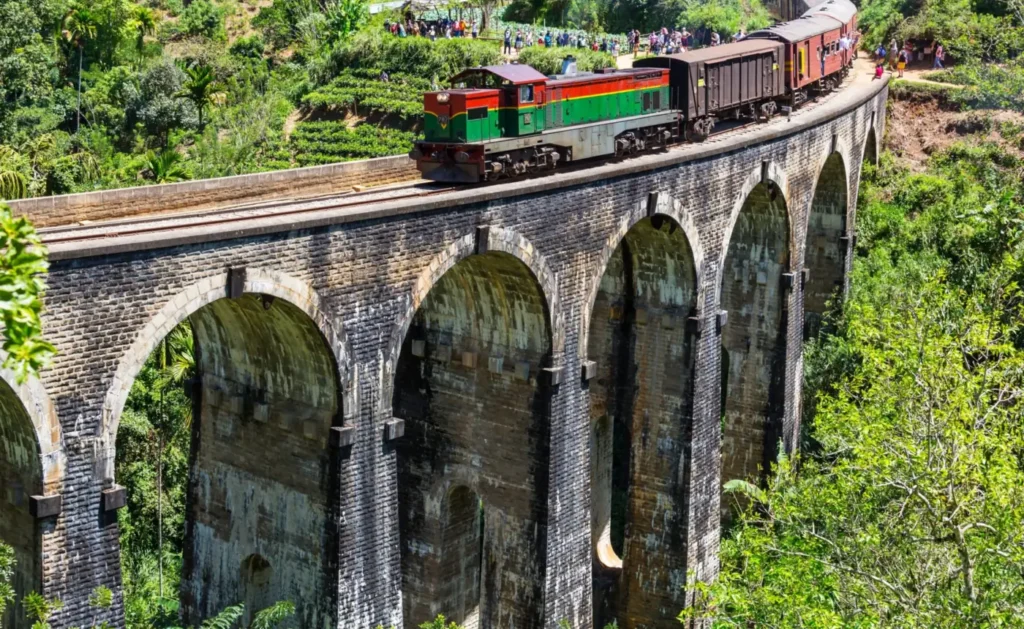
If you’ve come across the photo of a blue train curling through tea plantations, with someone leaning out an open doorway, it was almost certainly taken on the Nanu Oya to Ella line — Sri Lanka’s most photographed and most asked-about train journey. For roughly two and a half hours, it climbs and descends through some of the country’s most dramatic scenery, and it’s the single stretch of railway most first-time visitors build an entire hill-country itinerary around.
It’s also a piece of infrastructure that’s been through a genuinely difficult year. This guide reflects where things stand as of late September 2026, after Cyclone Ditwah (November 2025) damaged the hill country railway at over 200 locations — not the pre-cyclone “normal” timetable many older blog posts and booking sites are still quietly reproducing.
Is the Sri Lanka Hill Country Train Currently Operating?
Yes, but only partially:
- Nanu Oya ↔ Ella ↔ Badulla: Operating, on a full weekly pattern — three services a day most days, one on Wednesdays (detail below).
- Kandy ↔ Nanu Oya: Not operating. Closed for repairs, with no confirmed reopening date as of the most recent update (5 September 2026).
- Colombo ↔ Kandy: Not operating for through hill-country travel. An October 2026 resumption was flagged by the Railway Department’s chief engineer, but not yet reflected in a published timetable.
In practice: you can’t board a train in Kandy or Colombo and ride through to Ella. Reach Nanu Oya by road first, then join the train there — and since Nanu Oya–Ella is widely considered the best-looking stretch of the whole line, most travelers don’t feel short-changed.
Summary table
| Route | Trains per day | Operating Days | Reservation |
| Nanu Oya/Ambewela → Ella → Badulla | 2 (peak days) / 1 (Wed) | Thu–Tue: 2 daily · Wed: 1 only | Reserved & unreserved available |
| Badulla → Ella → Ambewela/Nanu Oya | 2 (peak days) / 1 (Wed) | Thu–Tue: 2 daily · Wed: 1 only | Reserved & unreserved available |
Train schedules can change due to railway operations, maintenance, weather and other circumstances. Always verify your train before departure.
Nanu Oya to Ella Train Schedule
| Train No. | Departs Nanu Oya | Passes Ambewela | Days of Operation | Continues to |
| Train 1005 | 9:00 AM | ~9:30–9:35 AM | Thu–Tue (not Wed) | Ella, then Badulla |
| Train 1043 | 1:00 PM | ~1:30–1:35 PM | Wednesdays only | Ella, then Badulla |
| Train 1015 | 3:00 PM | ~3:30–3:35 PM | Thu–Tue (not Wed) | Ella, then Badulla |
All three depart Nanu Oya first, reaching Ambewela roughly 30–35 minutes later, then continue via Pattipola, Ohiya and Haputale to Ella and Badulla.
Only Train 1005’s arrival is officially confirmed — Ella ~11:15 AM, Badulla 12:16 PM (about 2h15m to Ella). Trains 1043 and 1015 should take a broadly similar 2–2.5 hours, but this isn’t officially published — check the departure board on the day.
Train 1043 (Wednesdays) descends from the original “Ella Odyssey” tourist train, which ran a shortened Ambewela–Badulla route from January 2026 before being extended back to Nanu Oya. If you want its more tourist-oriented carriages, this is the one to ask about when booking.
Ella to Nanu Oya Train Schedule
| Train No. | Departs Badulla | Days of Operation | Arrives Ambewela / Nanu Oya |
| Train 1044 | 7:45 AM | Wednesdays only | Ambewela ~10:58 AM (historical); on to Nanu Oya shortly after |
| Train 1016 | 9:00 AM | Thu–Tue (not Wed) | Ambewela then Nanu Oya, several hours later |
| Train 1006 | 3:00 PM | Thu–Tue (not Wed) | Nanu Oya 6:06 PM |
Intermediate stations: Haputale, Ohiya, Pattipola, Ambewela. Only Train 1006 is officially confirmed end to end (Badulla 3:00 PM → Nanu Oya 6:06 PM, passing Ella roughly 3:45–3:55 PM). Trains 1044 and 1016 should run a similar overall length, but confirm exact timing at the station.
Timetables can change, so verify your service with Sri Lanka Railways before travel — via the reservation portal, by phone, or at the station.
Current Railway Operations & Service Updates
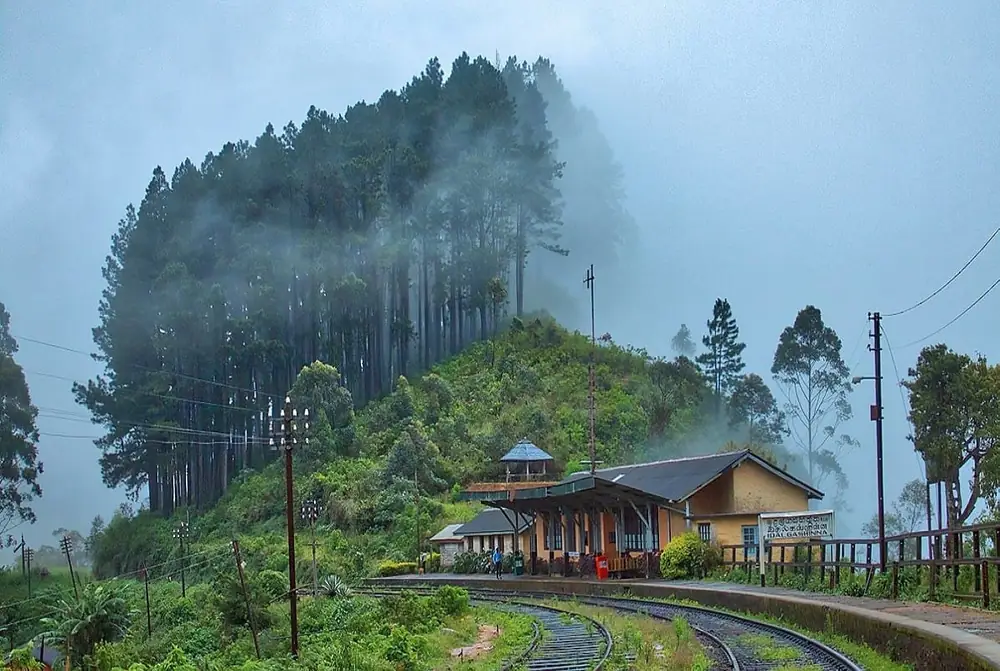
Cyclone Ditwah struck Sri Lanka in November 2025, and the subsequent flooding caused landslides, washouts, track subsidence and bridge damage at more than 200 locations along the Colombo–Badulla main line — the railway’s most geologically exposed and historically important route. Damage estimates varied by report, with Railway Department officials citing tens of billions of Sri Lankan rupees in damage to this line alone. Whatever the exact figure, this was one of the most disruptive events in the railway’s modern history. Recovery has come in stages:
- Late 2025: Main line service reduced to Colombo Fort–Rambukkana only.
- 7 January 2026: A shortened weekly Ella Odyssey resumed (Badulla 7:45 AM → Ambewela 10:58 AM; Ambewela 1:30 PM → Badulla 4:15 PM), subject to NBRO safety clearance.
- 20 June 2026: Four daily trips resumed on Nanu Oya–Badulla — the core of today’s 1005/1015/1006/1016 pattern.
- 18 July 2026: Nanu Oya–Ella reopened fully; the current six-day-plus-Wednesday timetable took shape.
- Early September 2026: Colombo–Kandy remained closed, with five sites between Rambukkana and Kadugannawa still under repair. An October 2026 resumption was flagged but not yet published; Kandy–Nanu Oya had no confirmed date.
Treat the Nanu Oya–Ella–Badulla timetable as normal, stable operation since July 2026. Treat the absence of Kandy–Ella or Colombo–Ella service as temporary and cyclone-related — it will change once repairs finish. Be wary of any listing still advertising a “Kandy to Ella train ticket.” If your date falls on a Wednesday, you get only one departure each way (1043 outbound, 1044 inbound) instead of two — plan around it.
The Nanu Oya–Ella Journey
Outbound
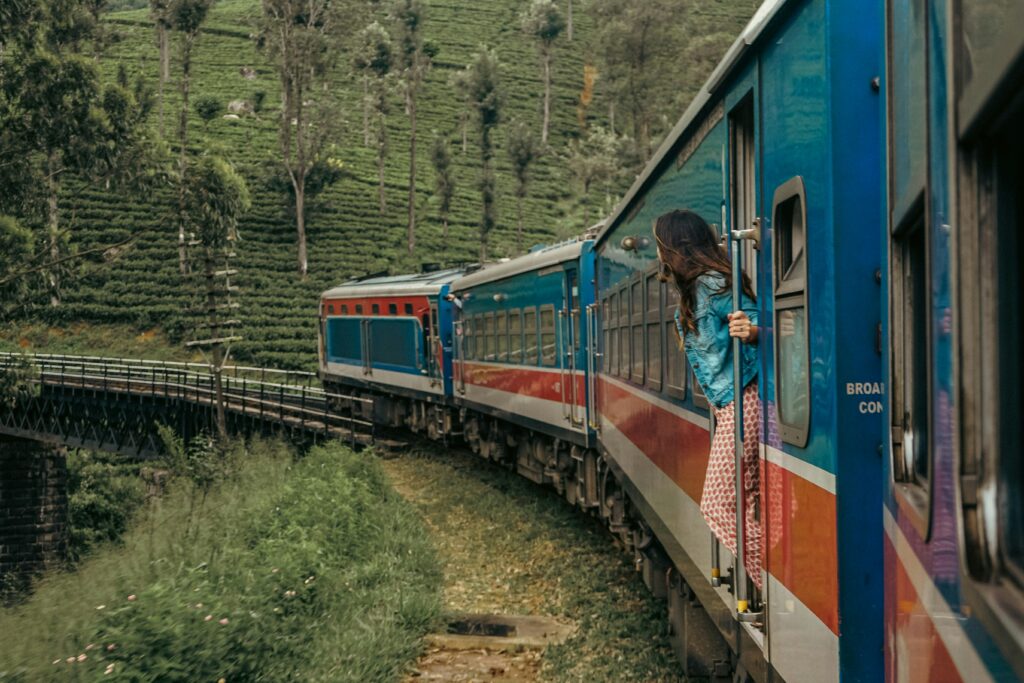
The journey covers about 34 kilometers and takes roughly 2h15–2h30m, with delays of 15–30 minutes fairly common.
Heading toward Ella, the train climbs from Nanu Oya into tea estates and the wide, cool grasslands around Ambewela (the first stop, ~30 minutes in, sometimes compared to New Zealand’s dairy country for its green, open character), then continues past Pattipola — Sri Lanka’s highest railway station, at close to 1,900 meters — and Ohiya, the access point for Horton Plains and World’s End. It descends through ridge-top Haputale, with views opening toward the southern lowlands on a clear day, past small tea-growing villages and forested valleys, and approaches Ella via the Demodara loop, a rare railway spiral, and the Nine Arch Bridge, visible from the train just before Demodara station. Expect tunnels cut through solid rock, iron truss bridges over ravines, glimpsed waterfalls, and tea bushes running right up to the track — this is a working passenger railway, not a purpose-built tourist ride (aside from the Wednesday Ella Odyssey-descended service).
Safety: passengers can generally move between carriages, and standing in open doorways for photos is common — and where the real risk lies. Doorways often have no barriers, and the train doesn’t always slow for curves or bridges; there have been incidents of falls or injuries. Keep a firm grip and be especially careful in tunnels and on bridges.
Views & light: the left side is more often recommended for views heading to Ella, though this varies by stretch and isn’t an exact science. Morning departures (Train 1005) offer the clearest light and best photography conditions; afternoon services see more cloud, especially in wetter months.
Return
The same scenery unfolds in reverse, and several recent travelers note it feels equally scenic and sometimes less crowded than the outbound direction. The Demodara loop and Nine Arch Bridge come near the start of the journey rather than the end — useful if photographing the bridge is a priority, since you get the shot early while you’re freshest. The right side generally offers the better view heading back toward Nanu Oya, though as with the outbound leg this varies by stretch and isn’t an exact science. From Nanu Oya, onward travel to Nuwara Eliya still requires the short road transfer covered below — there’s no rail connection toward Kandy or Colombo from here. With two return departures most days (Train 1016 in the morning and Train 1006 in the afternoon), a day trip from Ella to Nuwara Eliya and back is realistic; on Wednesdays, with only the single 1044/1043 pairing, a same-day round trip is tighter and worth checking carefully before committing to it.
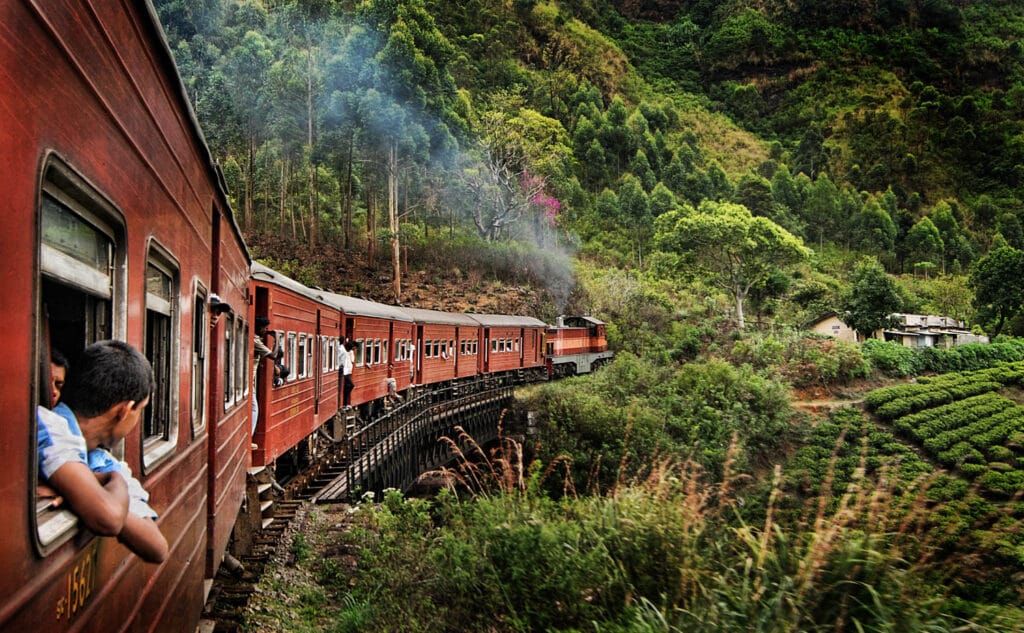
Important Railway Stations
- Kandy — Sri Lanka’s cultural capital and the historic starting point of the hill country climb; not currently rail-connected to Nanu Oya or Ella, so travelers heading up must continue by road.
- Peradeniya — a short distance from Kandy, notable for the Royal Botanical Gardens and as a junction point on the wider rail network.
- Hatton — the usual railhead for pilgrims and hikers heading to Adam’s Peak (Sri Pada), and a hub for the surrounding tea estates.
- Nanu Oya — the railway station most travelers use to access Nuwara Eliya, and the starting point for all three current outbound services.
- Ambewela — known for dairy farms and open, cool grassland scenery; the first stop on every outbound train, about 30 minutes out of Nanu Oya.
- Pattipola — the highest railway station in Sri Lanka, at close to 1,900 meters above sea level.
- Ohiya — the access point for Horton Plains National Park and the World’s End viewpoint, popular with hikers.
- Haputale — a ridge-top town with sweeping views and access to the Dambatenne Tea Factory and Lipton’s Seat viewpoint.
- Ella — Sri Lanka’s most visited hill country tourist town and a major stop on the railway (see below).
- Badulla — the historic terminus of the hill country line and the provincial capital of Uva Province; the origin or destination for every current service.
Nanu Oya is not Nuwara Eliya itself — the town sits a 20–30 minute tuk-tuk or taxi ride away, longer in heavy traffic, fog or rain. The station is small, with no formal luggage storage, so plan accordingly for a one-way trip.
Ella has grown into a major destination in its own right, known for valley-view guesthouses, hikes up Little Adam’s Peak and Ella Rock, and the Nine Arch Bridge. The station sits close to the town center.
Tickets, Classes & Booking Timing
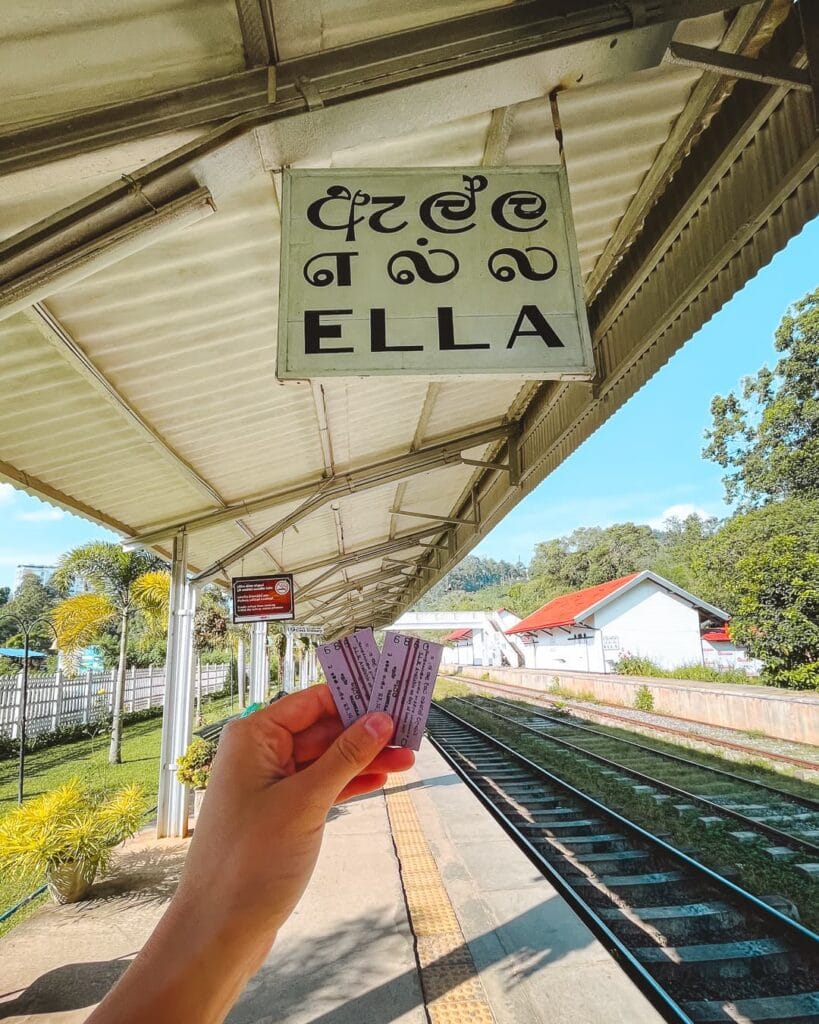
A reserved ticket guarantees a specific seat; an unreserved ticket (usually third class) lets you board without a guaranteed seat, so you may need to stand on a busy service.
Book via: the official Sri Lanka Railways reservation portal (seatreservation.railway.gov.lk), ticket counters at major stations including Nanu Oya and Ella (during specified hours), Mobitel M-Ticketing (dial 365, for Mobitel numbers), or a licensed local travel agent who typically charges a modest handling fee. Bring your booking confirmation, printed or on your phone, plus photo ID when collecting or boarding with a reserved ticket — procedures can vary slightly by station, so arrive with time to spare. Foreign visitors face no special restrictions on buying tickets, but online payment can be trickier with overseas cards and phone numbers, so many travelers book through a local agent or their hotel instead.
Classes: not every train carries every class. First class, where available, typically means air-conditioned or open-window observation-style seating — the Wednesday 1043/1044 pairing, given its Ella Odyssey heritage, is more likely to carry upgraded seating, but confirm at booking. Second class is reserved with fans. Third class is the cheapest, often unreserved, and perfectly comfortable for this length of journey with a window seat. Always confirm your specific train’s composition rather than assuming.
Booking window: reservations typically open 30 days before travel, usually around 9–10 AM Sri Lanka time — though this rule has shifted before without much notice. Reserved seats on the 9:00 AM Train 1005 and the Wednesday service sell out fastest; the 3:00 PM services (1015/1006) usually have more availability. If you miss the window, unreserved third class is normally still available at the station on the day, though you may need to stand.
Best Train for Tourists?
There’s no single “best” train — it depends on what you’re optimizing for:
- Scenery: broadly similar across all five services, since they share the same track.
- Reservation availability: the 9:00 AM Train 1005 and Wednesday’s 1043 sell out fastest; the 3:00 PM services are easier to secure.
- Comfort: first class or observation seating (where carried) is the upgrade; the Wednesday service may have an edge given its tourist-train history.
- Timing & photography: the 9:00 AM departure means cooler temperatures, better light and less midday haze.
- Convenience: the Thursday–Tuesday two-train pattern is simpler to plan around than Wednesday’s single working.
Practical Tips for the Journey
- Arrive at least 30 minutes early, more if collecting a reserved ticket
- Check whether your travel date is a Wednesday — the timetable is different that day
- Keep your ticket and ID accessible; confirm your train number and platform before boarding
- Travel light — a backpack or daypack, not a large suitcase
- Keep valuables secure, especially in crowded unreserved carriages
- Carry water, snacks, and a light jacket — temperatures drop at altitude
- Prepare for rain even on a clear-looking morning
- Never stand or lean dangerously near open doors, especially in tunnels or on bridges
- Avoid blocking doorways for other passengers, even while taking photos
- Be considerate of local commuters who use this line for everyday travel, not just tourism
- Take your rubbish with you and keep the carriage and platform clean
- Double-check your train number before boarding, especially if two services are at the platform close together
- Confirm your platform or track number at the station rather than assuming
- Check for delays or last-minute changes on the day, particularly in the rainy season
Luggage & Weather
Realistically, this isn’t a train built for large suitcases. Reserved carriages have limited overhead and under-seat space, and unreserved third-class carriages can get genuinely crowded on popular departures, where a wheeled hard-shell case is awkward to manage if you need to stand. A backpack or soft duffel is far more practical for this leg; if you’re carrying more for a longer trip, consider transferring your main bag separately by road (many hotels can arrange this) and taking only a daypack on the train. Neither Nanu Oya nor Ella station has formal luggage storage, so plan ahead rather than relying on finding it on the day.
The hill country line runs through Sri Lanka’s central highlands, where weather can shift quickly regardless of season. Rain and fog are possible year-round, more frequent during the two monsoon periods that affect different parts of the island at different times, and heavy rain has historically been the trigger for this line’s more serious disruptions, including landslides and washouts. December to March is generally the clearer, drier window for hill country travel, though it’s also the busiest period for tourism and reservations. Whatever the season, treat published schedules as a plan rather than a guarantee, and build slack into any tight onward connections.
Book Your Sri Lanka Tour with Hopscotch Travels

Getting the timing, transfers and the rest of your trip to line up is a different job from reading a timetable — and it’s one Hopscotch Travels Sri Lanka handles every week.
We can arrange:
- Your Nanu Oya–Ella train tickets, booked in the 30-day reservation window so you’re not left with an unreserved third-class seat on a full train
- A private vehicle and driver for the Kandy–Nanu Oya road leg, timed to connect smoothly with your train
- Accommodation in Nuwara Eliya and Ella, chosen for proximity to the station and the kind of stay you actually want
- A full hill-country itinerary — Kandy, Nuwara Eliya, Ella, and onward to the south coast or wherever you’re headed next
- A private chauffeur-guided tour of Sri Lanka, if you’d rather see the country at your own pace with the train as one highlight among several
Whether you need just the tickets sorted or a complete door-to-door itinerary, get in touch with Hopscotch Travels and tell us your dates — we’ll handle the planning so the only thing you have to do is show up at the platform.
Contact Hopscotch Travels to start planning your Sri Lanka trip →